The M57 in a few lines
Launched in 1998, the M57 is a common-rail direct-injection diesel straight-six, in 2.5 and above all 3.0 litre form. Its block is cast iron, a heavy but very robust base, with an aluminium cylinder head and four valves per cylinder.
Its timing chain sits at the front of the engine. That detail matters: on the four-cylinder N47, the chain is housed at the gearbox end, and replacing it means taking the engine out. On the M57, the chain is accessible and, above all, it rarely causes trouble.
You find it across a very wide range: 325d, 330d and 335d in the 3 Series, 525d, 530d and 535d in the 5 Series, 635d, 730d, X3 3.0d and 3.0sd, X5 3.0d, 3.0sd and 30d/35d, X6 xDrive35d. It was replaced from around 2008 by the N57, with the changeover stretching to 2013 depending on the model.
Three generations, three profiles
The M57 name actually covers three fairly different engines, and the generation changes what you need to watch.
The first generation (M57D25 and M57D30, roughly 1998 to 2003, Euro 3) produces 163 to 193 hp. You find it in the E46 330d, the E39 525d and 530d, and the E53 X5 3.0d. It is the simplest: no particulate filter, and more rugged injectors.
The second (M57TU, roughly 2003 to 2006, Euro 4) goes from 177 to 231 hp, with piezo injectors that are more precise but more sensitive. It powers late E46 330d models, the E60 and E61 525d and 530d, the E65 730d, the E83 X3 3.0d and the E53 X5. The particulate filter arrives gradually during this period.
The third (M57TU2, roughly 2006 to 2010, Euro 5 on the last ones) ranges from 197 to 286 hp. The most powerful versions, 335d, 535d, X5 3.0sd and later 35d, get two-stage twin-turbocharging: a small turbo for low revs and a large one for power. Particulate filter as standard.
The year of first registration is not enough to settle it: a car registered in early 2004 may have been built in late 2003. The production date is what counts.
Swirl flaps: the only real risk of engine failure
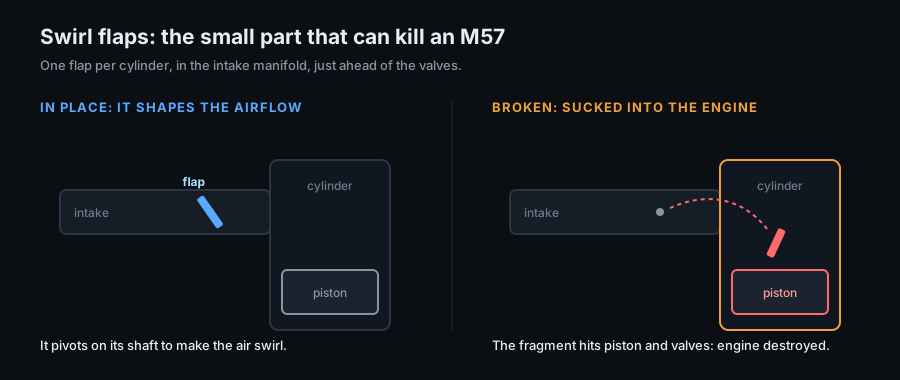
In the intake manifold, each cylinder has a small flap mounted on a spindle. At low revs, it partly closes the port to make the air swirl and improve combustion. It is an emissions part.
Over time, soot and oil deposits from exhaust gas recirculation clog these flaps, and the spindle develops play. One day, the flap or its screw comes loose and gets sucked into the cylinder. It then hits the piston and valves at full speed. The result is most often a destroyed engine, or a cylinder head and piston to replace.
The risk becomes serious from around 130,000 km, and it gives no warning. That is why most informed owners have the flaps replaced with new ones, or remove them using blanking plugs along with an engine computer remap. The job costs a few hundred dollars, against several thousand for an engine.
Be aware that removal touches an emissions component: it can have consequences at the MOT or roadworthiness test and for the vehicle's compliance. Fitting new flaps is the safest solution on that front. Either way, on a used car, the question to ask is simple: have the flaps been dealt with, and is there an invoice?
The damper pulley: the failure that leaves you without steering assistance
The M57's crankshaft pulley incorporates a vibration damper, made of a rubber ring sandwiched between two metal parts. With heat and age, that rubber dries out, cracks, then comes unbonded.
The signs are visible with the bonnet open: cracked or bulging rubber, a pulley that wobbles as it turns, a belt that squeals or walks off line. The problem usually appears between 160,000 and 270,000 km.
If the pulley comes apart, the accessory belt is thrown off. You then suddenly lose power steering assistance and battery charging, and sometimes the water pump depending on the version. It is not an engine failure, but it is a dangerous breakdown on the road.
Replacement is preventive, simple and inexpensive compared with the risk. On a car approaching or past 160,000 km with no record of replacement, it is an item to budget for.
Turbos: the normal wear of a big diesel
On single-turbo versions, service life is often between 250,000 and 300,000 km, sometimes much more. A turbo that whistles abnormally, smokes blue or lacks boost is at the end of its life.
The two-stage twin-turbo versions (335d, 535d, 3.0sd, 35d) are more complex. They have a control flap between the two turbos that can seize or crack, and a full repair costs considerably more. A loss of power in the mid-range, when the large turbo should take over, is the classic symptom.
In both cases, turbo longevity depends mostly on the oil: regular changes, and a few seconds of idling before switching off after a fast drive.
Injectors, EGR valve, particulate filter
The piezo injectors of the later generations are precise but sensitive to fuel quality. Beyond about 180,000 km, they can cause hard starting, a rough idle or black smoke. A leak-off test identifies the faulty injector before you replace all of them.
The exhaust gas recirculation valve clogs up with short trips, which also feeds the fouling of the swirl flaps. Cleaning it every 60,000 to 80,000 km avoids a lot of trouble.
The particulate filter, fitted to late Euro 4 and Euro 5 versions, does not like purely urban use: it needs regular fast runs to regenerate. The air mass meter, at around 180,000 km, and the glow plugs complete the list of classic wear parts.
The weak points and their budget
Observed orders of magnitude, parts and labour at an independent garage. Main dealer prices are higher.
Swirl flaps
$210 - 470Preventive replacement. Do it before they break.
Damaged engine
$4,200 and upIf a flap has been sucked into a cylinder.
Damper pulley
$310 - 570Preventive at around 160,000 km.
Turbo
$1,000 - 4,200The top of the range applies to two-stage twin-turbos.
Injector
$310 - 620 eachTest before replacing all six.
EGR valve
$260 - 620Cleaning or replacement depending on condition.
What the VIN and the history change
Decoding the chassis number gives the real production date and the exact engine. That is what tells you which generation of M57 sits under the bonnet, and so which injectors, which type of turbocharging and whether a particulate filter is likely to be fitted.
It also confirms the advertised version. A 535d or an X5 3.0sd is worth considerably more than a 530d or a 3.0d, and a badge proves nothing. The VIN tells you which engine the car received at the factory.
The service history completes the picture: regular oil changes, visits within the dealer network, and sometimes a record of the flaps, the pulley or a turbo being replaced. Work done at independent garages does not always appear: ask for the paper invoices too.
The right buy is an M57 whose generation you know, whose flaps have been dealt with, and whose oil changes are regular. With those three things in place, 250,000 km on the clock is nothing to worry about.
The maintenance that makes the difference
Oil changes remain the first item. The long factory intervals are often considered too far apart: widespread practice is to change the oil every 10,000 to 12,000 km, with an oil meeting the BMW LL-04 specification on versions with a particulate filter.
The turbo, the injectors and the timing chain all benefit from clean oil. It is the main reason some M57s go well past 400,000 km while others give up long before.
For the rest: cleaning the EGR valve at regular intervals, a fast run now and then for the particulate filter, and a visual check of the damper pulley at every oil change beyond 150,000 km. The timing chain deserves a check after 250,000 km, no more.
Which version to choose
The first-generation E46 330d and E39 530d are the simplest and easiest to maintain. They also show their age: overall condition matters as much as the engine.
The second and third-generation E60 and E61 530d and E90 330d are the most numerous on the market. A good compromise between performance, fuel consumption and reliability, provided the flaps have been dealt with.
The two-stage twin-turbo 335d, 535d and X5 3.0sd or 35d offer impressive performance for a diesel. They call for a flawless history, as their turbocharging costs more to put right.
The E53 and E70 X5 add the costs that come with a large SUV, all-wheel drive and, depending on the version, air suspension. The engine is generally not the problem: it is the rest of the car that needs inspecting.
Checklist before buying an M57-powered BMW
The order to follow.
- ·Decode the VIN: exact engine, real production date, and therefore engine generation.
- ·Ask whether the swirl flaps have been replaced or removed, with an invoice.
- ·Inspect the damper pulley: cracked or bulging rubber, or a wobbling pulley.
- ·Read the history: regular oil changes, work on the turbo, injectors and EGR valve.
- ·Have the fault codes read, especially those for turbocharging, injectors and the particulate filter.
- ·On a twin-turbo, check that it pulls strongly in the mid-range, with no flat spot and no limp mode.
- ·Listen to a cold start and check for blue or black smoke.
- ·Price what remains to be done and build it into the offer.
Should you buy one
Yes. The M57 is among the best diesels BMW has ever built, and it is one of the few engines in this series of articles that can be recommended without any fundamental reservation. Its base is robust and its timing drive does not suffer from the N47's problems.
The condition is to deal with the one major risk before it shows up: the swirl flaps. Once that is sorted and the damper pulley is being watched, the rest is the normal wear of a big diesel.
As always, pay for a documented car rather than for a low mileage. An M57 at 280,000 km with its invoices is often worth more than one at 150,000 km with no maintenance record at all.