The N20 in brief
The N20 marks BMW's move into downsizing: it replaced engines such as the naturally aspirated N53 six, promising lower consumption and emissions for similar performance. A turbocharged four took the place of a straight six, which upset the purists, but emissions rules left little choice.
Built from 2011 to 2017, the N20 is a turbocharged inline-four with direct injection. It comes in two displacements: 1.6 litres (N20B16) and 2.0 litres (N20B20), the latter by far the most common.
Technically it packs what BMW did best at the time: twin-scroll turbo, Valvetronic variable valve lift, Double VANOS variable valve timing, an electric water pump and an open-deck aluminium block. Compression ratio is 10.3:1 and the redline sits at 7,000 rpm across every version, unusual for a turbo four.
The 1.6 makes around 170 hp and 250 Nm. The 2.0 comes in four steps: roughly 156 hp (240 Nm), 184 hp (270 Nm), 218 hp (310 Nm) and 245 hp (350 Nm). That spread explains why it appears in so many models.
Which models have it
The N20 was fitted widely across the 2010s range: 1, 2, 3, 4 and 5 Series of the F generation, X1, X3, X4 and X5 in four-cylinder form, plus the Z4 E89 as sDrive18i, 20i and 28i.
In practice a 320i, 328i, 520i or X3 xDrive20i from this period is almost always an N20. Model badges stopped following displacement long ago: a "28i" with 245 hp is a 2.0-litre turbo four, not a straight six. That is a frequent source of confusion in classified ads, sometimes deliberately maintained.
This matters more than it sounds. On earlier generations a 28i meant a six-cylinder. A buyer chasing the smoothness and sound of a straight six who buys an F30 328i without checking will be disappointed. Decoding the VIN removes the doubt in seconds.
N20 or N26: the variant to know about on imported cars
There is a version of the N20 called the N26, built to meet the American SULEV emissions standard, particularly strict in California. Mechanically it is the same engine with the same performance.
The differences are in the fuel system, with stainless steel lines and a specific pump outlet valve, an electronically controlled turbo wastegate, and a dual catalytic converter setup. None of this changes how the car drives.
Why it matters to you: if you are looking at a BMW imported from the United States, there is a good chance it has an N26 rather than an N20. The specific parts can take longer to source in Europe, and a workshop ordering N20 references for an N26 will waste your time. Decoding the VIN identifies the engine actually fitted and the car's original market.
The weak point: the timing chain guides
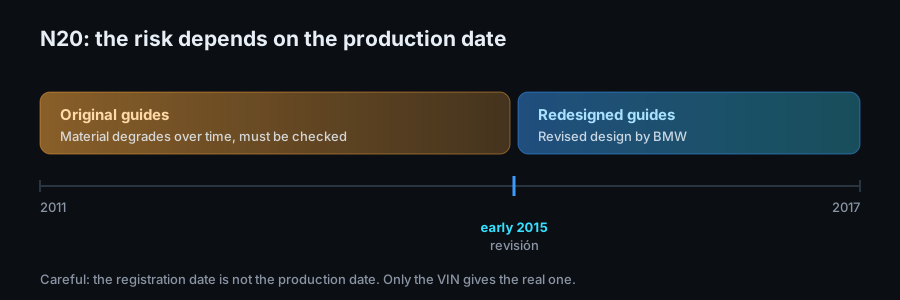
This is the uncomfortable part, and it deserves to be taken seriously. On early production years, the plastic guides that hold the timing chain were made from a material that degrades prematurely. As they age they crack, then break.
The consequence is mechanical and brutal: without guides the chain goes slack, jumps teeth, and timing between crankshaft and camshafts is lost. Valves then meet pistons. At that point you are no longer talking about a repair but an engine rebuild, or a replacement.
The classic early warning is a metallic rattle when cold, coming from the rear of the engine on the gearbox side, usually clearest on start-up. A check engine light may also appear with crankshaft/camshaft correlation fault codes. If you hear that noise on a test drive, walk away or get the job quoted before you negotiate anything.
One more documented limit of this engine, less dramatic but real: intake air temperatures climb quickly, especially under sustained load. That hurts efficiency when hot and caps tuning potential.
Two useful habits on a test drive: insist on a genuinely cold start, after the car has sat overnight, because the noise fades once the oil is warm. And be wary of a seller who warmed the car up before you arrived. It is not always innocent.
Before or after 2015: the detail that changes everything
BMW redesigned these guides in early 2015. Engines built after that revision are considered significantly safer on this specific point. So that is the first thing to establish on a car you like.
Watch out for the trap: the first registration date does not tell you the production date. A car registered in 2015 may well have been built in 2014, with the older guides. Relying on the registration document is a coin flip.
In the United States, a class action settled in 2017 led to warranty coverage extended to 7 years or 70,000 miles on this component. That measure was specific to the American market and does not apply in Europe, but the scale of the response tells you how big the problem became.
On budget, two very different situations. Preventive replacement of the chain and guides is labour-heavy, since access means removing part of the front of the engine: expect well over a thousand dollars, depending on model and workshop. If the chain has already jumped and valves have met pistons, you change scale entirely and the bill can exceed the value of an older car. That is the whole difference between anticipating and enduring.
What the VIN and service history tell you
This is where the chassis number becomes your best tool. Decoding the VIN gives the car's real production date, not its registration date. So you know immediately whether you are before or after the 2015 revision.
The service history goes further. It lists workshop visits with the work carried out. If the timing chain or its guides have already been replaced, it is there. A pre-2015 N20 whose timing has been redone in the official network is a far more reassuring proposition than a 2016 car with no history at all.
The history also lets you cross-check the mileage recorded at each visit. On an engine whose longevity depends on regular servicing, a consistent record with sensibly spaced oil changes is worth more than a low, unexplained odometer reading.
Servicing: what makes an N20 last
Direct injection has a known downside on petrol engines: fuel no longer washes the intake valves, which gradually build up carbon deposits. On a high-mileage car, or one used mostly for short trips, walnut blasting may become necessary. That is maintenance, not a failure, but it costs money.
The electric water pump and its thermostat are wear items on this engine. Replacement is a common, well-documented job, worth budgeting for on a car approaching or past 150,000 km with no record of the work.
Finally, an N20 lives better with shorter oil change intervals than the extended ones originally specified. A history showing regular oil changes is a far better signal than a low odometer.
The B48 successor, and what it says about the N20
From 2017 the N20 gave way to the B48, part of BMW's new modular architecture. Both share the essentials (twin-scroll turbo, direct injection, Valvetronic, Double VANOS), but the B48 uses a closed-deck block, forged internals where the N20 used cast parts, and a revised compression ratio. All of which answers the N20's known limits directly.
That does not make the N20 a bad engine, but it does confirm BMW had identified room for improvement. If your budget lets you choose between a late N20 and an early B48 at comparable mileage and service history, the B48 is the calmer choice.
The checklist before buying an N20
A summary of what to check, in order:
- ·Decode the VIN to get the exact production date, not the registration year.
- ·Establish whether the engine predates or follows the early 2015 guide revision.
- ·Look through the service history for any work on the timing chain or its guides.
- ·Listen to the engine from genuinely cold, watching for a rattle at the rear of the block.
- ·Check that recorded mileages are consistent across workshop visits.
- ·Confirm the advertised specification matches the factory configuration.
So should you avoid the N20?
No. Hundreds of thousands of N20s run without incident, and the engine is pleasant, flexible and reasonably economical for its performance. Its successor brings a closed-deck block and stronger internals, but that does not invalidate the N20.
The message is simple: this engine should not be bought blind. A documented car, with a known production date and a coherent service history, is a good buy. A car with no verifiable past is a gamble, and the cost of losing runs into thousands.