The N63 in a few lines
Launched in 2008, the N63 is a 4,395 cc V8 fed by two turbochargers, with double overhead camshafts, 32 valves and Double VANOS. Bore is 89 mm, stroke 88.3 mm, the compression ratio is 10.0 to 1, and the whole engine weighs around 228 kg.
Depending on version and model year, output ranges from 408 to 530 hp, with 600 to 750 Nm of torque available very low in the rev range. This is a grand tourer engine before it is a sports engine: it is built for shove, not for revs.
It powers a very wide range: 5 Series as 550i and M550i, 6 Series as 650i, 7 Series as 750i and 750Li, 8 Series as M850i, X5 and X6 as xDrive50i then M50i, X7 M50i, and the Alpina B8. It has even been used outside the group, notably in recent Range Rovers.
In short, if you are looking at a high-end petrol BMW from the last fifteen years, there is a good chance it is an N63. And the only question that matters is: which one?
The hot-V: the common cause of almost everything
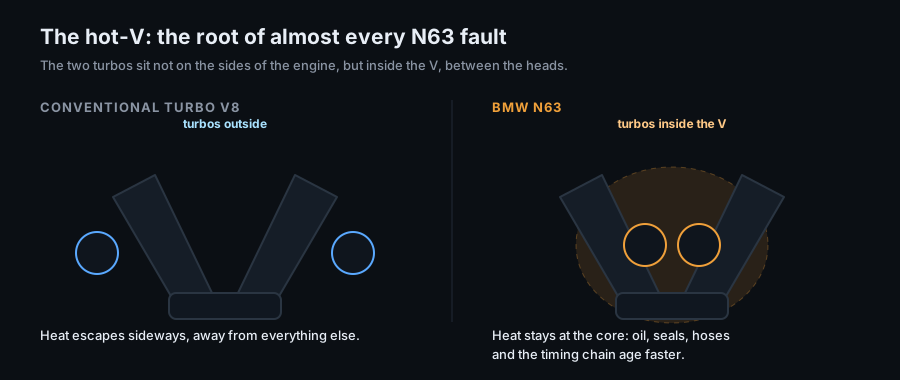
On most turbocharged V8s the turbos sit outside the cylinder heads, on either side of the engine. On the N63, BMW placed them inside the V, in the valley between the two banks. This layout is called the hot-V.
The benefits are real: exhaust runs are very short, so turbo response is immediate, and the engine is more compact, which makes it easier to package under the bonnet. This was not an engineer's whim, it was a rational choice.
The price is just as real. Two turbos working red hot end up trapped at the centre of the engine, right above the sump and next to everything that dislikes heat. Oil cooks faster, seals harden, hoses age, and the timing chain works in a hotter environment.
Remember that sentence, because it explains the rest: on the N63, almost every known failure is a thermal consequence. It is also why maintenance has such an outsized effect on how long this engine lasts, in both directions.
Four generations, and that is the whole question
The N63 has been thoroughly revised three times. The differences are not cosmetic: they are direct answers to failures seen in the field.
The first generation, from 2008 to 2014, is the one that built the engine's reputation. You will find it in the X5 and X6 xDrive50i, the F10 550i, the 650i and the F01 750i. It is also the only one that deserves genuine caution.
The N63TU, from 2012 and widely used between 2014 and 2019, brings Valvetronic, new valve stem seals, lighter pistons, a forged crankshaft and connecting rods, an oil separator in the valve cover, a second coolant pump and a revised fuel system. The list reads like an admission of failure, and that is exactly what it is.
The N63TU2, from 2016, moves to twin-scroll turbochargers, redesigns the pistons with more oil drain reliefs and relocates the oil cooler. You will find it in the G11 750i and the G30 M550i.
Finally the N63TU3, from 2018, adds a crossover tube between the intercoolers, new ignition coils, larger turbochargers with diverter valves and higher-pressure injectors. This is the version in the M850i, X5 M50i, X7 M50i and Alpina B8, and by far the most relaxed one to own.
What breaks on the first generation, and the budget
Here are the items that keep coming back, with orders of magnitude observed in Europe. The figures vary a lot by workshop and model, but they give the right scale.
Valve stem seals
$4,100 - 7,300Blue smoke on startup. Heavy job, the heads are involved.
Turbochargers (the pair)
$4,100 - 7,300Insufficient lubrication, permanent heat.
Timing chain
$3,100 - 5,200Suffers from heat and from tired oil.
Injectors (all eight)
$2,100 - 3,600Over-fuelling, long cranking, misfires.
Assorted leaks
$400 - 1,600Upper sump gasket, valve cover, turbo oil lines.
Intake carbon cleaning
$520 - 930Scheduled maintenance, every 80,000 to 120,000 km.
How one failure drags in the next
The chain of events described by workshops is almost always the same, and it is worth understanding. Injectors that deliver too much fuel raise internal pressure in the cylinder. That excess pressure stresses the top end, and in extreme cases it has been enough to crack blocks.
In parallel, failing piston rings and hardened valve stem seals let oil into the combustion chamber. That is the origin of the blue smoke and the oil consumption that made this engine notorious.
The turbos and the chain, for their part, suffer from insufficient lubrication in an environment that is too hot. These are not badly designed parts, they are badly served parts.
Finally, coolant leaks are the most brutal scenario. Coolant that enters a cylinder does not compress: the engine stops dead, and it is usually lost. It is rare, but it is why a cooling leak on an N63 is never postponed until next month.
Failures reported on the first generation do not always come late. Cases are documented from 45,000 km, many before 100,000 km, and the threshold beyond which serious trouble becomes common is often placed around 160,000 km.
BMW's goodwill programme in 2015
Faced with mounting cases, BMW launched a free engine care programme in 2015, reserved for N63-equipped cars and covering several known weak points. The manufacturer always refused to call it a recall.
That detail matters to a buyer. A car that went through the programme may have received revised parts at the manufacturer's expense, which changes its real value. Another one, never presented to a dealer, still has its original parts.
This information does not appear in an advert. It appears in the service history, job by job, and it is one of the best reasons to read it before buying this engine in particular.
The battery, the symptom nobody blames on the engine
Many N63 owners have reported batteries dying well before their normal life, often after only a few days parked. The issue was widespread enough in the United States to result in a class action settlement concluded in 2019.
The practical value is that a seller rarely mentions this, and a buyer naturally blames a tired battery rather than the car.
If the history shows several batteries replaced in a few years, that is not routine servicing. That is a clue.
Symptoms to catch on the test drive
Blue smoke on a cold start, or after a long idle, is the most telling signal. It means oil is getting through, so valve stem seals or piston rings. Ask to start the engine stone cold, and stand behind the car.
Abnormally long cranking, misfires or an intermittent engine light point towards the injectors or the high-pressure pump.
An oil level that drops between services is almost expected on the early generations. The real question is not whether it uses oil, but how much, and the seller should be able to answer.
Finally, look for traces under the engine and for the smell of warm coolant. On this block, a leak that is starting is never a minor subject.
What the VIN changes on this engine in particular
On the N63, decoding the chassis number is not a convenience, it is the decisive piece of information. It gives the real factory date and the exact engine version, therefore the generation.
The registration year does not answer that question. Generation changes happen mid-year, sometimes months apart depending on the model and the market. A car registered in 2015 can perfectly well carry a first-generation engine.
This is exactly the situation where the gap between two apparently identical cars is measured in thousands of euros of repairs to come. A first-generation X5 xDrive50i and a late X5 M50i do not tell the same story, and the advert does not make that distinction.
The service history completes the picture: participation in the manufacturer programme, turbo replacement, injectors, seals, and how regularly the oil was changed. On an engine where everything flows from heat and oil, that regularity weighs more than the mileage on the clock.
The maintenance that genuinely changes life expectancy
Oil changes come first, by a long way. The long intervals originally specified are considered wholly inadequate for this engine. The recommended practice is to come down to around 8,000 km, with a quality full synthetic oil meeting the manufacturer's specification.
This is not overzealous: on an engine whose turbos and chain work in a red-hot zone, the oil's ability to hold up under heat is the main survival factor. Tired oil cooks, degrades, and stops protecting the parts that cost the most.
Walnut blasting the intake is the second item. It belongs to scheduled maintenance, not to repair, at intervals of around 80,000 to 120,000 km. Direct injection makes the deposit unavoidable.
Finally, the cooling system deserves more attention than average. Hoses, pumps, expansion tank: on this engine, a small neglected leak is the start of a very large problem.
Which N63 car to choose
If the budget allows, aim for a late generation, from 2018 onwards: M850i, a recent M550i, X5 M50i, X7 M50i or Alpina B8. These versions received every correction, and their field reputation has little in common with the early years.
The N63TU2, from 2016, is a good compromise. Twin-scroll turbos and revised pistons fix a significant share of the complaints, at a much more accessible price.
The N63TU, between 2014 and 2019, remains reasonable provided you demand a complete history. This is the generation where servicing quality creates the widest gap between two cars.
The first generation, finally, is not bought without a file. If the price is very attractive, assume the difference matches the work still to come, and do the maths before you negotiate rather than after.
Checklist before buying a BMW with an N63
The order to follow.
- ·Decode the VIN: exact engine version and real production date, therefore generation.
- ·Read the history: participation in the manufacturer care programme, turbos, injectors, seals.
- ·Start the engine stone cold while standing behind the car, and watch for blue smoke.
- ·Ask for the real oil consumption between services, in litres.
- ·Have the fault codes read, in particular on the injection and ignition side.
- ·Check how often the oil was actually changed, not the number of stamps.
- ·Look for leak traces under the engine and check the condition of the coolant hoses.
- ·Look at how many batteries were replaced and how quickly.
- ·Price the remaining work and build it into the offer.
Should you be afraid of it
The honest answer comes in two parts. A first-generation car with no history, sold well below market, is a gamble many people have lost. That is not a forum legend, it is a widely documented fact.
But a recent N63, or an older car that was properly looked after, with close oil changes and the known points already addressed, is a completely different proposition. It is a smooth, quiet and extremely fast V8, available at a price no comparable engine would reach without that reputation.
So the rule is simple and slightly ironic: on the N63, the engine's bad reputation is your best bargaining tool, provided you know exactly which one you are looking at. That is precisely what the chassis number tells you in seconds.