The S55 in a few lines
Introduced in 2014, the S55 is a 2,979 cc straight-six fed by two turbochargers, one per bank of three cylinders. Bore is 84 mm, stroke 89.6 mm and the compression ratio 10.2 to 1. It derives from the N55 used in the 335i and 435i, but it was heavily reinforced for its sporting role.
The block uses a closed-deck design, stiffer than the N55's, the cylinders receive a sprayed coating instead of conventional liners, and fuel is supplied by two pumps. These reinforcements are what allow it to handle far more power than its official ratings.
Output depends on the version: 431 hp for the base M3 and M4, 450 hp with the Competition package, 460 hp for the M3 CS and M4 CS, 500 hp for the M4 GTS. The M2 Competition gets it at 410 hp, the M2 CS at 450 hp. Torque ranges from 550 to 600 Nm.
You find it in the F80 M3 from 2014 to 2018, the F82 coupé and F83 convertible M4 from 2014 to 2020, and the F87 M2 in Competition and CS form until 2021. Its successor, the S58, powers the next generation.
The crank hub: what exactly are we talking about
The crank hub is the part fitted to the end of the crankshaft that drives the timing chain. It keeps the engine's rotation synchronised with the opening of the valves. If it moves, even slightly, the engine's timing is thrown off.
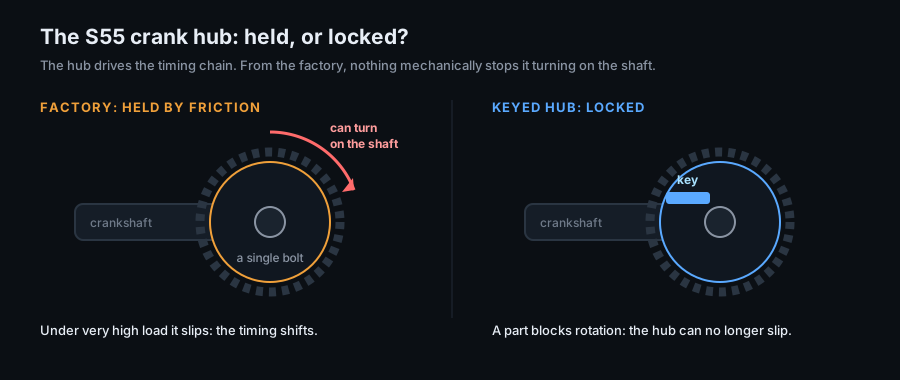
On the S55, as on the N55 it inherits the design from, this hub is not mechanically locked to the shaft. There is no key and no pin. It is held by a single central bolt and a friction washer: clamping force is the only thing stopping it from turning.
In normal use, that clamping force is more than enough. The problem appears under very high, sudden loads: repeated launch control starts, violent downshifts, or above all the extra cylinder pressure that comes with engine tuning. The friction joint can then slip.
When the hub turns on the shaft, the timing shifts. In the best case, the engine drops into limp mode with a warning. In the worst case, valves and pistons meet, and the bill changes scale.
Who is really exposed
This is the most often misunderstood point. Available reports put the frequency below 1 % of S55 engines, and the vast majority of cases involve tuned cars or cars used intensively on track.
On a strictly standard M3 or M4 driven on the road, the risk exists but it is low. The hub was sized for the factory power output, with a margin.
The picture changes as soon as power goes up. A simple remap adds a lot of torque, and it is precisely torque, applied suddenly, that loads the joint. Add repeated launch control starts and you have the typical profile of a car that ends up spinning its hub.
In other words, the question to ask in front of a used S55 is not only whether the engine has a flaw, but how the car was used, and whether it has been modified.
The symptoms, and why they arrive without warning
Unlike a chain that wears and eventually gets noisy, hub slip gives no warning. It is not a wear item you can hear ageing: it slips in one go, under a specific load.
The signs appear afterwards: a drivetrain malfunction warning, limp mode, rough idle, hesitation and misfires. The engine computer detects that the timing has moved and reports it.
If it happens to you, do not keep driving. Timing that has shifted within tolerable limits can be corrected along with a hub replacement. An engine pushed on in that state risks valve-to-piston contact.
The fix: a locked hub
The remedy is well known and widely proven: replace the factory hub with a one-piece hub, keyed or pinned, mechanically locked to the crankshaft. It can no longer turn, whatever the load.
On a tuned or track car, it has become an almost systematic upgrade, often done at the same time as the remap. Expect around $1,600 to $2,600 for parts and labour depending on the workshop, as the job requires precisely re-timing the engine.
Lighter preventive solutions also exist, reinforcing the central bolt without changing the hub. They reduce the risk but do not offer the same guarantee as a mechanical lock.
On an M3 or M4 left standard and driven on the road, the upgrade is not essential. It does become a real negotiating point on a tuned car that has not received it.
The other weak points and their budget
The hub dominates the debate, but it is not what will most often cost an owner money. Here are the recurring items, with orders of magnitude observed in Europe.
Locked hub (preventive)
$1,600 - 2,600Almost essential on a tuned car.
Damaged engine
$10,400 and upIf the hub slipped and valves met pistons.
Charge pipe
$310 - 620Plastic boost pipe, cracks mostly after tuning.
Valve cover
$410 - 830Leaking gasket, plastic cover that cracks, around 120,000 to 160,000 km.
Oil filter housing
$160 - 360Leaking gasket, sometimes from 80,000 km.
Intake carbon cleaning
$520 - 930Scheduled maintenance, inherent to direct injection.
Oil leaks, the real day-to-day of the S55
The valve cover gasket is the most common leak. It can appear at around seven years of age and becomes frequent between 120,000 and 160,000 km. The signs: a smell of hot oil, smoke on the passenger side, a low oil warning, or oil on the spark plug threads. The plastic cover itself can crack with heat.
The oil filter housing gasket follows closely. It is a simple, inexpensive repair if caught early, but oil running onto the accessory belt can damage it if left too long.
The oil pan gasket leaks more rarely and later, beyond 160,000 km. The part is cheap, but the job requires dropping the subframe, which brings the bill to around $830 to $1,240.
None of these leaks is serious in itself. They become a problem when ignored: an oil level that drops without being watched is the start of much more serious trouble.
What the VIN and the history change
On the M2, M3 and M4, the first question is not mechanical, it is commercial: which version are you really looking at? The gap between a base M4, a Competition, a CS and a GTS runs into tens of thousands, and a badge can be stuck on in five minutes.
Decoding the chassis number gives the exact version, the real production date and the factory equipment. It is the only reliable way to confirm that a CS is a CS, or that a car advertised with the Competition package actually received it at the factory.
The service history completes the picture: regular oil changes, work done within the dealer network, possible replacement of the hub or charge pipe. Tuning done outside the network will not necessarily show up: on these models, ask the question explicitly and request the invoices.
It is the combination of the two that is worth gold. An authentic M4 Competition, dealer-serviced, standard and with a regular history is a safe buy. The same car, remapped without a locked hub and with no maintenance record, is a gamble.
The maintenance that makes the difference
Oil changes remain the first item. The long intervals specified by the factory are considered too far apart for an engine of this output: common practice among informed owners is to come down to around 8,000 to 10,000 km, with an oil meeting the manufacturer's specification.
Checking the oil level between changes is the best way to spot the leaks described above early. On a car used on track, tired oil and stressed bearings do not mix well: some owners of hard-used cars replace the rod bearings preventively.
Walnut blasting the intake belongs to scheduled maintenance, as direct injection makes deposits inevitable over the years. Replacing the spark plugs, more frequent on a tuned engine, follows the same logic.
Tuning: why it changes the whole calculation
The S55 is one of the easiest BMW engines to develop. A remap and a few parts commonly take it past 500 hp, and heavier builds with uprated turbos and internals go beyond 700 hp.
That ease has an obvious downside: the used market has many modified cars, some done well, some not. And it is precisely on those cars that the hub, the charge pipe and the bearings work hardest.
A seriously tuned S55, with a locked hub, a metal charge pipe, close maintenance and invoices, can be an excellent buy. A hastily remapped S55 with none of those precautions combines every risk the engine has.
Which M2, M3 or M4 to choose
The F82 M4 coupé is the most common, so the easiest to find and compare. It is also the one with the largest supply of tuned cars: history matters more there than anywhere else.
The F80 M3 saloon offers the same mechanicals with four doors, and often sells for slightly less at equal mileage. It is an excellent compromise for daily use.
The M2 Competition, more compact and lighter, gets the S55 at 410 hp. Many consider it the best-balanced of the family, and its values remain firm.
The CS and GTS versions play in another category, that of limited editions. Their value depends entirely on their authenticity: on these cars, verification by chassis number is not a precaution, it is a prerequisite.
Checklist before buying an S55-powered M2, M3 or M4
The order to follow.
- ·Decode the VIN: exact version (Competition, CS, GTS), real production date, factory equipment.
- ·Ask whether the car has been tuned, and get the invoices for every modification.
- ·On a tuned car, check that a locked hub has been fitted.
- ·Read the history: regular oil changes, work within the dealer network.
- ·Have the fault codes read, especially those related to timing.
- ·Check for leaks around the valve cover and the oil filter housing.
- ·Ask about use: road, track, frequent launch control starts.
- ·Price what remains to be done and build it into the offer.
Should you be afraid of it
No, provided you put the crank hub in its proper place. It is a real but rare risk, concentrated on one specific kind of car: tuned, driven brutally, without the locked hub that settles the question.
For the rest, the S55 is a robust engine whose common weaknesses come down to classic oil leaks and the maintenance that goes with direct injection. Nothing that justifies avoiding a well-kept M3 or M4.
So the real rule on these models is the rule of the whole M range: pay for an authentic, documented car rather than for a quoted power figure. That is exactly what the chassis number and the history let you verify.