The N47 in brief
The N47 is a 2.0-litre common-rail turbo diesel four, launched in the late 2000s to replace the M47. At the time it brought clear gains in consumption, emissions and refinement over its predecessor.
Depending on the version it produces roughly 115 to 205 hp. You find it across a very large part of the range: 1 Series (118d, 120d, 123d), 3 Series (316d, 318d, 320d), 5 Series (518d, 520d), plus the X1 and X3. In short, a four-cylinder BMW diesel from this period is almost always an N47.
That sheer volume is exactly why the subject grew so large: when a flaw affects an engine built in huge numbers, it quickly becomes a forum phenomenon.
The real problem: a chain mounted at the rear
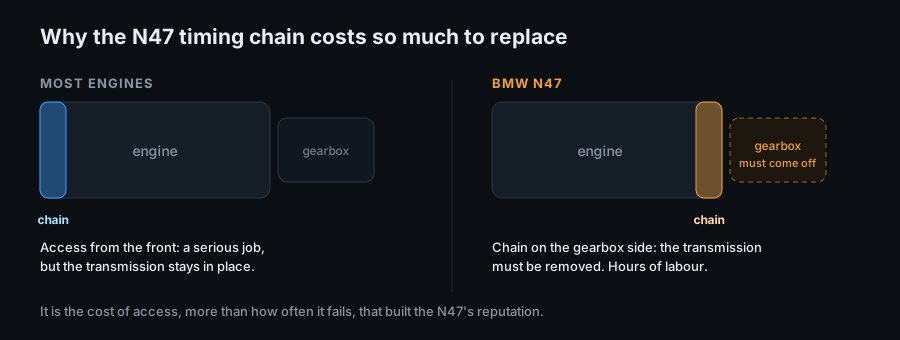
On most engines the timing chain sits at the front of the block, on the accessory side. On the N47 it is at the rear, next to the gearbox and flywheel. That layout is the heart of the problem, though not for the reason people assume.
The N47 chain tends to stretch prematurely. As it stretches it goes slack, can jump teeth and, in the worst case, break. Timing between crankshaft and camshafts is then lost, and valves meet pistons. At that point the engine needs a major rebuild.
What makes the N47 so feared is that its rear position means uncoupling the gearbox to get to it. Where a conventional chain replacement is already a serious job, on the N47 it becomes a project: the bill runs into thousands, almost entirely in labour. It is that cost, more than how often the failure happens, that built the engine's reputation.
The symptoms that should stop you
The most characteristic sign is a metallic chain rattle on a cold start, coming from the rear of the engine, on the bulkhead and gearbox side. It can sound like a rattle or a rubbing noise, and it may fade once the engine warms up, which should absolutely not reassure you.
Other signals point the same way: crankshaft/camshaft correlation fault codes, an engine running poorly, difficult starting, or an unexplained loss of flexibility.
A simple rule on a test drive: insist on a genuinely cold start, ideally after the car has stood overnight. If the seller warmed the car up before you arrived, ask to come back. On this particular engine that is not excessive suspicion, it is the only moment when the noise is clearly audible.
Which model years are affected
Early production years are the most exposed. BMW revised the chain and its components several times over the engine's life, and later cars are considered safer.
But it is only honest to say, and this is an important difference from the N20 petrol engine, that there is no single clean cut-off date after which everything was solved. The changes came gradually, and owners of late cars still report cases. Settling for "it is a late one, so it is fine" is a mistake.
The practical conclusion is the same as for any used purchase: you do not judge a car on its build year alone, you judge it on its history.
What the VIN and service history reveal
This is where the chassis number turns a gamble into a decision. Decoding the VIN gives the car's real production date, not its first registration year, which can differ by several months and completely skew your judgement.
The service history goes further, and on this engine it is the single most valuable piece of information available. It lists workshop visits with the work carried out: if the timing chain has already been replaced, it is there. An N47 whose timing has been redone is an entirely different proposition from one with an unknown past, and that is easily worth a difference in price.
The history also lets you check how regularly the oil was changed. On an engine whose chain suffers from tired oil, a record showing frequent oil changes is an excellent signal, often better than a low, unexplained odometer.
Other things to watch on an N47
The chain takes all the attention, but this diesel has the classic weaknesses of its category, which should not be overlooked:
Swirl flaps
Carbon build-up or mechanical wear. Hesitation and poor pick-up.
EGR valve and intake
Carbon deposits choking airflow and hurting performance.
Diesel particulate filter
Blockages typical of short trips and interrupted regeneration.
Turbocharger
Wear, oil-related faults and actuator problems, leading to limp mode.
Cooling system
Failures can cause overheating. Watch on high-mileage cars.
Head gasket
Rare, but it happens, often after mishandled overheating.
Servicing: what really protects the chain
The best ally of an N47 chain is clean oil at the right pressure. The extended oil change intervals specified at the time are now widely considered far too long for this engine.
Shortening oil changes, with an oil meeting the manufacturer specification, is the most effective and least expensive way to protect the timing. It is also what separates, in a service record, a maintained car from one that was merely driven.
Finally, a chain noise is not something you ignore or postpone. The gap between a costly preventive replacement and a destroyed engine is considerable.
The B47 successor, and should you avoid the N47?
From the mid 2010s the B47 replaced the N47 as part of BMW's new modular architecture. It addresses most of the criticism levelled at its predecessor and enjoys a much calmer reputation.
So should you avoid the N47 altogether? No, and that shortcut costs many buyers dearly. Hundreds of thousands of them run without incident, and some have already had their chain replaced, which makes them particularly reassuring and often well worth the asking price.
The real message is this: the N47 is an engine you do not buy blind. Documented, with a known production date and a coherent history, it is a good deal, often discounted by an excessive reputation. Without a verifiable past, it is a gamble measured in thousands.