The S65 in a few lines
Introduced in 2007, the S65 is an all-aluminium naturally aspirated V8 of 3,999 cc, with double overhead camshafts, 32 valves, Double VANOS and, above all, eight individual throttle bodies, one per cylinder. It shares nothing with the brand's regular V8s: it descends directly from the S85 V10 of the M5 E60, whose architecture it takes with two cylinders removed.
Quoted output is 414 hp at 8,300 rpm, with 400 Nm at 3,900 rpm and a redline at 8,400 rpm. Compression ratio is 12.0:1. The engine weighs around 202 kg, which makes it one of the lightest V8s of its generation.
It powers the M3 E90 saloon, E92 coupé and E93 convertible from 2007 to 2013, with either a 6-speed manual or the 7-speed M-DCT dual clutch. An enlarged 4,361 cc version making 444 hp, the S65B44, powered the M3 GTS and the M3 CRT between 2010 and 2012, in very small numbers.
Those figures say the essential thing: this is a civilised race engine. It only gives its best above 6,000 rpm, and that is also why it demands a servicing discipline that has nothing in common with an ordinary straight six.
Subject number one: the rod bearings
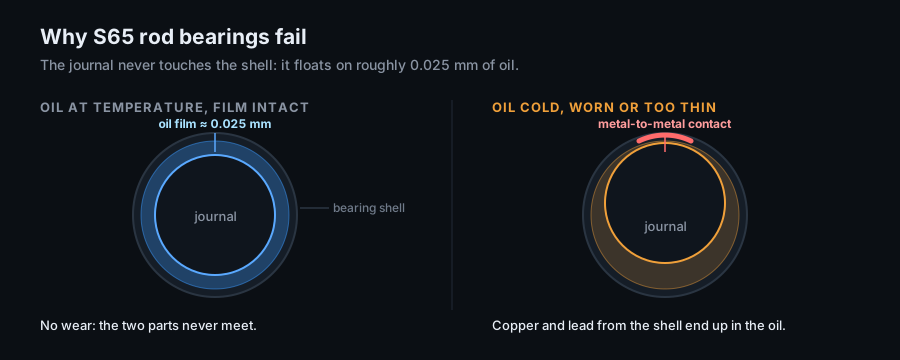
This is the fault that built the engine's reputation, and it deserves to be understood rather than feared. A rod bearing is not meant to touch the crankshaft. Between the two there is a permanent pressurised oil film, roughly 0.025 mm thick, which means the two parts never meet.
On the S65 that gap is unusually tight, a direct consequence of an engine designed to rev very high. The smaller the clearance, the harder it is to maintain a continuous oil film inside it. If that film breaks, even intermittently, metal rubs on metal and the bearing, softer than the crankshaft, wears.
What follows is mechanical. The copper and lead particles torn from the bearing enter the oil and circulate through the whole engine. Clearance grows, noise appears, and in cases left alone the rod eventually lets go. That is the difference between a few thousand in repairs and an engine to replace.
In 2011 BMW changed the bearing composition, moving from a lead and copper alloy to a harder tin and aluminium one, for environmental reasons. Field reports do not suggest this reduced how often the problem occurs. In other words, a late car is not exempt from the same watchfulness.
When to replace them, and what it costs
Common practice in the community is to replace the bearings preventively, between 130,000 and 210,000 km, without waiting for any symptom. This is not a repair, it is scheduled maintenance, in the same way a timing belt is on another engine.
The job typically runs between $2,000 and $3,100, parts and labour included. The engine does not need to come out: the rods are reached from below, which keeps the bill lower than the figure might suggest.
Compare that with the other scenario. An S65 that has run with a degraded bearing means a crankshaft to regrind or a complete engine to replace, in the order of $20,000 to $28,000. The ratio between those two numbers explains why nobody argues about the value of doing it early.
There is a simple way to know where an engine stands without taking anything apart: oil analysis. A laboratory measures copper and lead content in a sample drawn at an oil change. Values rising from one change to the next indicate wear in progress. It costs very little, and it is the most profitable test you can run on this engine.
The other weak points and their budget
Rod bearings take all the attention, but they are not the only item to plan for on a V8 with mileage behind it. Here is what comes up most often, with orders of magnitude.
Rod bearings
$2,000 - 3,100Preventive between 130,000 and 210,000 km. Not optional.
Throttle actuator
$780 - 1,350 eachPlastic gears and a circuit board. There are two.
Valve covers
around $670 per bankWarp under heat. Gaskets alone: about $280.
Crankcase breather
$340 - 560Exhaust smoke and rising oil consumption.
Electric water pump
keep an eye on itReplacement advised around 160,000 to 210,000 km.
Idle control valve
modest itemRough or hunting idle. The good news here.
Throttle actuators, the second subject
The eight individual throttle bodies are driven by two electric actuators, one per bank. Inside are plastic gears and a circuit board. Both age: the teeth wear and eventually break, and the board suffers from repeated strain.
The failure is abrupt and recognisable. The engine drops into limp mode, power collapses, and the DSC and EML lights come on. The car still drives, but it will not go beyond a few thousand rpm.
The associated fault codes are well documented: 2B15, 2B16, 2B21, 2B57 and CDC0 depending on the exact fault. A simple diagnostic read points straight at the cause, which saves chasing false leads.
Specialist workshops rebuild these actuators rather than replacing them with new ones, fitting metal gears in place of the original plastic. That is considerably cheaper and reputed to last longer than the factory part.
Symptoms to catch on the test drive
Bearing noise is the one to learn. It is a dull metallic knock, low down in the engine, that shows up at idle with the engine hot and deepens when you vary the revs slightly. It does not sound like injector tick or timing chain rattle.
Be careful though: a bearing can be worn without making any noise at all. The absence of a knock is not a guarantee. That is exactly why oil analysis and service history beat your ear.
A rough idle, hunting revs or hesitation point towards the idle control valve or the VANOS system, whose solenoids can stick and cause power loss and a check engine light.
Finally, rising oil consumption, exhaust smoke or a whistle from the crankshaft seals point at the crankcase breather. That is a reasonable item, but you want it identified before you negotiate.
What the VIN and the history change
On this engine more than any other, the service history is the document that sets the price. The only question that really matters is whether the rod bearings have already been done, at what mileage, and with which parts. An M3 E92 whose bearings were replaced at 150,000 km with the invoice on file is objectively worth more than an identical car with no trace of it.
The history also lets you check how regular the oil changes were, which is the single biggest survival factor for the bearings. On an engine this sensitive to the quality of the oil film, a thin service record weighs more than high mileage.
Decoding the VIN completes the picture. It gives the real production date, the exact engine version and the factory configuration. That is useful for placing a car before or after the 2011 bearing revision, and for checking that a car presented as a Competition or a limited edition really is one.
On an M3 E9x this check is not excessive caution. Original options, the Competition package and rare finishes move the value significantly, and a badge proves nothing. The chassis number, on the other hand, cannot be repainted.
The servicing that makes the difference
Oil changes come first, by a long way. The long intervals specified at the time are universally judged too far apart for this engine. Informed owners drop to between 10,000 and 16,000 km, with a fully synthetic oil meeting the BMW specification.
Viscosity matters as much as frequency. An oil that is too thin, or worn out, will not hold a film inside a 0.025 mm clearance. That is the most direct and most avoidable cause of bearing wear.
Cold discipline is the second point, and it costs nothing. Until the oil is up to temperature, do not go beyond about 4,500 rpm. Coolant temperature rises quickly, oil temperature much more slowly: watch the oil gauge, not the water one.
Those two habits explain most of the gap between an S65 that covers 300,000 km without drama and one that fails at 140,000. The engine is not fragile, it is demanding, which is not the same thing.
Tuning: what the S65 actually accepts
It is worth being honest here, because this is a naturally aspirated engine and not a turbo. A tune on its own brings something like 20 to 30 hp, which is modest compared with what a forced induction six takes from the same work.
The usual gains stack up in small increments: a full exhaust for 15 to 25 hp, sports cats or test pipes for 10 to 20 hp, a carbon intake for 10 to 20 hp. We are still in the realm of fine tuning.
Head work changes the scale. Ported runners combined with more aggressive camshafts can add 40 to 50 hp, but at that point you are into built-engine territory, with the monitoring that goes with it.
The real break comes from forced induction. A supercharger kit such as the ESS VT2-625 takes the engine to around 600 hp, and built-block builds pass 700 hp. The trade-off is obvious: what was already the weak point, the bearings, works far harder. A supercharged S65 needs stricter servicing, not looser.
Which M3 E9x to choose
The E92 coupé is the most sought after and the best documented version, with its carbon roof and the silhouette that made the model's name. It is also the one whose values have climbed the most in recent years.
The E90 saloon is the only four-door M3 of this generation. It usually trades for less at equal mileage, for strictly identical mechanicals. It is objectively the best ratio between the driving and the money down.
The E93 convertible is heavier because of its folding hard top, and less prized by purists. In exchange it offers the naturally aspirated V8 with the roof down, which remains a difficult argument to counter.
The gearbox choice matters too. The 6-speed manual is the collectors' favourite and holds value better. The 7-speed M-DCT is quicker and more pleasant day to day, but it adds an expensive component to look after, with its own fluid services to respect.
The M3 GTS and CRT with the S65B44 play in another category, the collector one, with production runs in the tens to low hundreds. On those cars, verifying authenticity through the chassis number is not optional.
Checklist before buying an M3 E9x
The order to work through.
- ·Decode the VIN: exact engine version, real production date, factory equipment.
- ·Read the history: have the rod bearings been replaced, at what mileage, with what invoice.
- ·Ask for an oil analysis, or have one done before purchase: copper and lead content.
- ·Listen to the engine at hot idle while varying the revs slightly, and remember a worn bearing can stay silent.
- ·Have the fault codes read, particularly those of the throttle actuators.
- ·Check the real frequency of oil changes in the book, not just the number of stamps.
- ·On an M-DCT car, confirm its own fluid services have been done.
- ·Price the work still to come and build it into the offer rather than hoping to dodge it.
Should you be afraid of it
No, provided you buy with your eyes open. The S65 does not fail at random: it fails when you give it the servicing of an ordinary car. Close oil change intervals, the right oil, respected warm-up and preventive bearings, and it covers distance very well.
What you have to accept is a maintenance budget with nothing in common with a 335i. Keep a reserve, in the order of $1,700 to $2,200, so that you are never tempted to postpone a job that cannot be postponed.
The practical rule on this model is simple: pay for the history, not for the mileage. An M3 at 240,000 documented kilometres is a calmer purchase than the same car at 130,000 that nobody can account for.
And there remains the argument no spreadsheet captures: it is the last naturally aspirated V8 fitted to an M3, and there will be no more. That does not justify buying badly, but it explains why so many people accept the servicing programme that comes with it.